Shrimad Bhagavad Gita : Chapter-01
The Stage is Set for Silence Before the Storm:
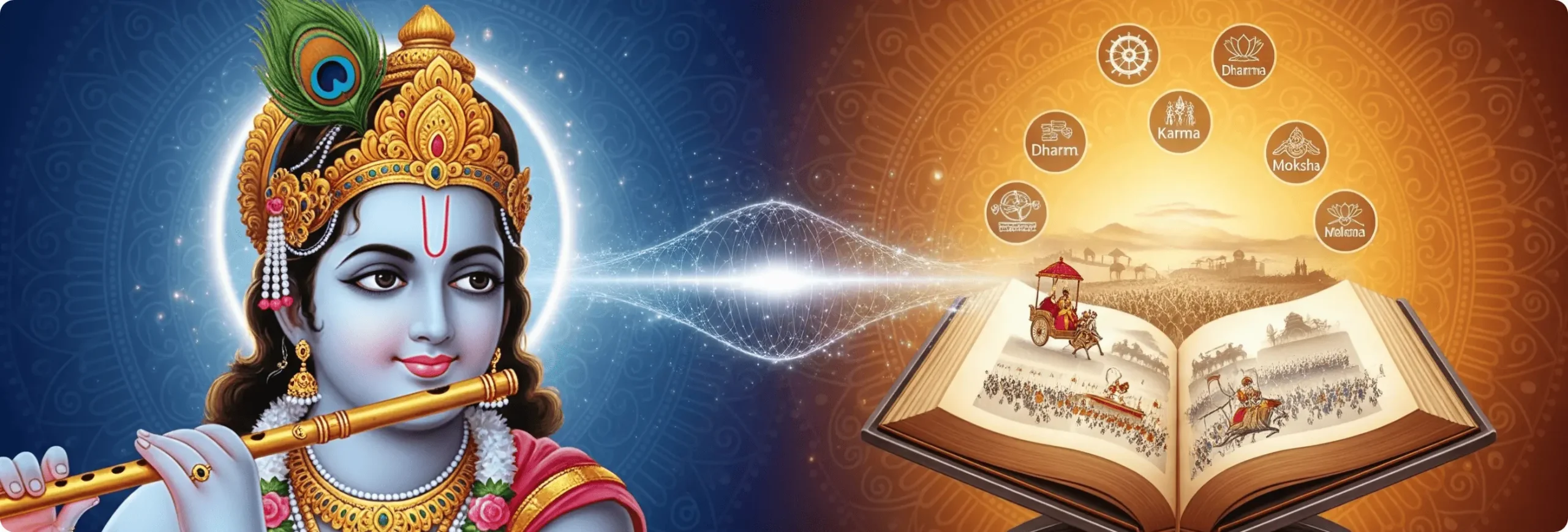
Chapter 1 introduces us to the ultimate, heartbreaking prelude to the epic battle of Kurukshetra. The vast armies of the righteous Pandavas and the ambitious Kauravas stand poised, ready to shatter a family and reshape a civilization. This is the moment of truth, the culmination of years of conflict.
Lord Krishna, acting as the charioteer, maneuvers the magnificent chariot of Arjuna, the supreme archer, to the very center of the battlefield—a vantage point between the two massive, bristling forces.
The Crisis of Conscience
As Arjuna surveys the ranks, the sight of his revered teachers, beloved grandfathers, cousins, uncles, and cherished friends standing as adversaries tears at his very soul. The expected thrill of war evaporates, replaced by a profound, paralyzing grief.
Arjuna’s logic shifts from duty to despondency. He foresees not victory, but an unparalleled tragedy: the destruction of his own lineage, the collapse of societal order (dharma), and the inevitable stain of sin (papa) that will follow the slaying of one’s own kin. The material gains of a kingdom seem utterly worthless when weighed against the monumental emotional and spiritual cost.
The Surrender
Overwhelmed, his body trembling and his famous Gandiva bow slipping from his grasp, the mighty warrior collapses into the back of his chariot. He rejects the battle, declaring, “I will not fight.”
This complete emotional and moral breakdown is the pivot on which the entire epic turns. The fear of losing loved ones and the dread of spiritual consequence forces the ultimate seeker to surrender to the ultimate guide. Arjuna, the warrior who stood ready to conquer the world, gives up his personal will and sits, broken, at the feet of Lord Krishna, effectively saying: “I am confused about my duty and overcome with pity. I ask you, tell me what is best for me.”
This Chapter is not about a fight; it is about the pause before the fight. It establishes the human condition of grief and moral confusion, creating the perfect, desperate necessity for the divine counsel that follows—the wisdom of the Bhagavad Gita.
Verse : 01
Dhritarashtra uvacha:
Dharma-kshetre kurukshetre samaveta yuyutsavah !
Mamakah pandavashchaiva kimakurvata sanjaya !!01!!
Meaning : Dhritarashtra said- O Sanjaya, after assembling on the holy field (dharma-kshetra) of Kurukshetra, being desirous to fight, what did my sons and the sons of Pandu do?
Verse : 02
Sanjaya uvacha
Drishtva tu pandavanikam vyudham duryodhanastada!
Acharyamupasangamya raja vachanamabravit!!02!!
Meaning: Sanjaya said- after seeing the army of the Pandavas arrayed in military formation, king Duryodhana approached his teacher (Guru) Dronacharya and spoke these words:
Verse : 03
Pashyaitam pandu-putranam acharya mahatim chamum
Vyudham drupada-putrena tava shishyena dhimata!!03!!
Meaning: Duryodhan said – “O acharya”! behold this mighty army of the sons of Pandu (pandavas), arrayed in a military formation by your brilliant disciple, the son of Drupada (Dhṛṣṭadyumna)..
Verse: 04-06
atra shura maheshvasa bhimarjuna-sama yudhi
yuyudhano viratashcha drupadashcha maha-rathah !!04!!
dhrishtaketushchekitanah kashirajashcha viryavan
purujit kuntibhojashcha shaibyashcha nara-pungavah !!05!!
yudhamanyushcha vikranta uttamaujashcha viryavan
saubhadro draupadeyashcha sarva eva maha-rathah !!06!!
Meaning: Here in this army are great archers and heroic warriors equal to Bhima and Arjuna in battle: Yuyudhana, Virata, and Drupada, the great chariot-fighter; Dhrishtaketu, Chekitana, the valiant King of Kashi, Purujit, Kuntibhoja, and Shaibya, the best of men; the powerful Yudhamanyu and the valiant Uttamauja; the son of Subhadra (Abhimanyu), and the sons of Draupadi—all of them are great chariot-fighters.
Verse : 07
asmakam tu vishishta ye tannibodha dwijottama
nayaka mama sainyasya sanjnartham tanbravimi te !!07!!
Meaning: “O best of the twice-born (Dronacharya), Know also the distinguished ones on our side—those who are especially qualified as the leaders of my army. I shall name them for your information.”
Verse : 08
bhavanbhishmashcha karnashcha kripashcha samitinjayah
ashvatthama vikarnashcha saumadattis tathaiva cha !!08!!
Meaning: “Yourself (Drona), and Bhishma, and Karna, and Kripa, the victorious in battle, as well as Ashvatthama, Vikarna, and the son of Somadatta (Bhoorishrava)”
Verse : 09
anye cha bahavah shura madarthe tyaktajivitah
nana-shastra-praharanah sarve yuddha-visharadah!!09!!
Meaning: “And there are also many other heroic warriors, who are prepared to lay down their lives for my sake. They are all equipped with various kinds of weapons, and all are highly skilled in the art of warfare.”
Verse : 10
aparyaptam tadasmakam balam bhishmabhirakshitam
paryaptam tvidametesham balam bhimabhirakshitam !!10!!
Meaning: “And our army, marshalled by Bhishma (Known as Pitamah), is insufficient; but their army, protected by Bhima, is sufficient.” – Interpretation_01
Meaning : “Our army, which is marshalled by Bhishma, is immeasurable (unlimited in strength), whereas the army of these Pandavas, which is protected by Bhima, is certainly measurable (limited)” – Interpretation_02
श्लोक : 11
ayaneshu cha sarveshu yatha-bhagamavasthitah
bhishmamevabhirakshantu bhavantah sarva eva hi !!11!!
Meaning : Therefore, stationed in your respective positions at all entrances, let all of you gaurd Grandsire Bhishma.
Verse : 12
tasya sanjanayan harsham kuru-vriddhah pitamahah
simha-nadam vinadyochchaih shankham dadhmau pratapavan !!12!!
Meaning: Sanjaya said- “Then, the powerful and glorious Grandsire Bhishma (Pitamahah), the oldest man of the Kuru dynasty, blew his conchshell very loudly, roaring a lion to produce joy in [the heart of] Duryodhana.”
Verse : 13
tatah shankhashcha bheryashcha panavanaka-gomukhah
sahasaivabhyahanyanta sa shabdastumulo ’bhavat !!13!!
Meaning: “Thereafter, conches, kettledrums, bugles, trumpets, and horns were all sounded suddenly and simultaneously, and that sound became tumultuous (overwhelming).”
Verse : 14
tatah shvetairhayairyukte mahati syandane sthitau
madhavah pandavashchaiva divyau shankhau pradadhmatuh !!14!!
Meaning: “Then, seated in a magnificent chariot yoked with white horses, both Madhava (Krishna) and the son of Pandu (Arjuna) blew their divine conchshells.”
Verse : 15
panchajanyam hrishikesho devadattam dhananjayah
paundram dadhmau maha-shankham bhima-karma vrikodarah !!15!!
Meaning: “Hrishikesha (Lord Krishna) blew his conchshell named Panchajanya; Dhananjaya (Arjuna) blew his, the Devadatta; and Bhima, the voracious eater and performer of herculean tasks, blew his great conchshell, the Paundra.”
Verse : 16-18
anantavijayam raja kunti-putro yudhishthirah
nakulah sahadevashcha sughosha-manipushpakau !!16!!
kashyashcha parameshvasah shikhandi cha maha-rathah
dhrishtadyumno viratashcha satyakish chaparajitah !!17!!
drupado draupadeyashcha sarvashah prithivi-pate
saubhadrashcha maha-bahuh shankhandadhmuh prithak prithak !!18!!
Meaning: “King Yudhishthira, the son of Kunti, blew his conchshell named Anantavijay (Endless Victory); and Nakula and Sahadeva blew their conchshells, Sughosh (Melodious Sound) and Manipushpak (Jeweled Blossom), respectively.”
The King of Kashi, an excellent archer; Shikhandi, the great chariot-warrior; Dhrishtadyumna, Virat, and Satyaki, the unconquered; King Drupada, the five sons of Draupadi,and the mighty-armed son of Subhadra (Abhimanyu)—all of them, each separately, blew their respective conchshells; O Lord of earth !”
Verse : 19
sa ghosho dhartarashtranam hridayani vyadarayat
nabhashcha prithivim chaiva tumulo abhyanunadayan !!19!!
Meaning: “That tumultuous sound, thundered accross the sky and the earth, certainly shattered the hearts of the sons of your; O Dhritarashtra.”
Verse : 20
atha vyavasthitan drishtva dhartarashtran kapi-dhwajah
pravritte shastra-sampate dhanurudyamya pandavah
hrishikesham tada vakyam idam aha mahi-pate !!20!!
Meaning: “At that moment, O King Dhritarashtra, the son of Pandu, Arjuna, whose flag bears the emblem of Hanuman (Kapi-dhvajaḥ), seeing your sons arrayed in battle formation, and as the discharge of weapons was about to commence, took up his bow and then spoke these words to Hrishikesha (Lord Krishna).
Verse : 21-22
arjuna uvacha
senayor ubhayor madhye ratham sthapaya me ’chyuta !!21!!
yavadetan nirikshe ’ham yoddhu-kaman avasthitan
kairmaya saha yoddhavyam asmin rana-samudyame !!22!!
Meaning: “Arjun said- O Acyuta (Krishna), please place my chariot in the middle, between the two armies. So that I may properly observe these warriors arrayed for battle, who are eager to fight, and ascertain with whom I must contend in this great trial of arms.
Verse : 23
yotsyamanan avekshe ’ham ya ete ’tra samagatah
dhartarashtrasya durbuddher yuddhe priya-chikirshavah !!23!!
Meaning: “I want to observe those who have come here to fight, intending to please the evil-minded son of Dhritarashtra (Duryodhana) in battle.”
Verse : 24
sanjaya uvacha
evam ukto hrishikesho gudakeshena bharata
senayor ubhayor madhye sthapayitva rathottamam !!24!!
Meaning: “Sanjoy said- O Bharata (Dhritarashtra), having thus been addressed by Gudakesha (Arjuna), Hrishikesha (Lord Kṛṣṇa) then drew the magnificent chariot between the two armies.”
Verse : 25
bhishma-drona-pramukhatah sarvesham cha mahi-kshitam
uvacha partha pashyaitan samavetan kurun iti !!25!!
Meaning: “In the presence of Bhishma, Drona, and all the other rulers of the earth, He (Lord Krishna) said, ‘O Parth (Arjuna), behold these Kurus assembled here!”
Verse : 26
tatrapashyat sthitan parthah pitrin atha pitamahan
acharyan matulan bhratrin putran pautran sakhims tatha
shvashuran suhridash chaiva senayor ubhayor api !!26!!
Meaning: “There (in the middle), Parth (Arjuna) could see stationed in both armies, his fathers, grandfathers, teachers, maternal uncles, brothers, cousins, sons, nephews, grand-nephews, friends, fathers-in-law, and well-wishers.”
Verse : 27
tan samikshya sa kaunteyah sarvan bandhun avasthitan
kripaya parayavishto vishidann idam abravit !!27!!
Meaning: “Seeing all those relatives present there, the son of Kunti (Arjuna) was overwhelmed by great compassion, and in deep sorrow, he spoke these words.”
Verse : 28
arjuna uvacha
drishtvemam sva-janam krishna yuyutsum samupasthitam
sidanti mama gatrani mukham cha parishushyati !!28!!
Meaning: “Arjun said- O Krishna, seeing these, my own kinsmen, arrayed here eager to fight, my limbs are quivering and my mouth is completely parching.”
Verse : 29
vepathush cha sharire me roma-harshash cha jayate
gandivam sramsate hastat tvak chaiva paridahyate !!29!!
Meaning: “And a trembling is coming over my body, and my hair is standing on end. The Gandiva (bow) is slipping from my hand, and my skin, too, is burning all over.”
Verse : 30
na cha shaknomy avasthatum bhramativa cha me manah
nimittani cha pashyami viparitani keshava !!30!!
Meaning: “I am also unable to stand steadily, and my mind seems to be reeling. And, O Keshava (Krishna), I see only unfavorable omens.”
Verse : 31
na cha shreyo ’nupashyami hatva sva-janam ahave
na kankṣe vijayam krishna na ca rajyam sukhani cha !!31!!
Meaning: “Nor do I see any good, O Krishna, after killing my own kinsmen in battle. I desire neither victory, nor kingdom, nor pleasures.”
Verse : 32-33
na kankshe vijayam krishna na cha rajyam sukhani cha
kim no rajyena govinda kim bhogair jivitena va !!32!!
yesham arthe kankshitam no rajyam bhogah sukhani cha
ta ime ’vasthita yuddhe pranams tyaktva dhanani cha !!33!!
Meaning: “Arjun Said: O Krishna, I do not desire victory, nor a kingdom, nor the ensuing pleasures. O Govinda, what use is a kingdom to us? What use is enjoyment, or even life itself?” All those for whose sake we desire the kingdom, enjoyments, and happiness – They are standing here on the battlefield, ready to give up their lives and wealth.
Verse : 34-35
acharyah pitarah putras tathaiva cha pitamahah
matulah shvashurah pautrah shyalah sambandhinas tatha !!34!!
etan na hantum ichchhami ghnato ’pi madhusudana
api trailokya-rajyasya hetoh kim nu mahi-krite !!35!!
Meaning: “Teachers, fathers, sons, as well as grandfathers, maternal uncles, fathers-in-law, grandsons, brothers-in-law, and other relatives, too—O Madhusūdana, I do not wish to slay them, even if they attack me. Why would I kill them for the sake of this Earth, when I wouldn’t do it even for the sovereignty of the three worlds?”
Verse : 36
papam evashrayed asman hatvaitan atatayinah
tasman narha vayam hantum dhartarashtran sa-bandhavan
sva-janam hi katham hatva sukhinah syama madhava !!36!!
Meaning: “Sin will accrue to us by killing these aggressors. Therefore, it is not proper for us to kill the sons of Dhṛtarāṣṭra along with their friends.O Madhava, how can we possibly be happy after slaying our own kinsmen?”
Verse : 37-38
yady apy ete na pashyanti lobhopahata-chetasah
kula-kshaya-kritam dosham mitra-drohe cha patakam !!37!!
katham na jneyam asmabhih papad asman nivartitum
kula-kshaya-kritam dosham prapashyadbhir janardana !!38!!
Meaning: “Although these men, whose hearts are overpowered by greed, see no fault in the destruction of the family (clan) or sin in treachery toward friends, O Janardana, why should we, who clearly see the crime of destroying a family, not learn to turn away from this sin?”
Verse : 39
kula-kshaye pranashyanti kula-dharmah sanatanah
dharme nashte kulam kritsnam adharmo ’bhibhavaty uta !!39!!
Meaning: “With the destruction of the family (Kula), the eternal family traditions (kula-dharmas) perish. When Dharma is lost, the entire family is certainly overtaken by irreligion (adharma).”
Verse : 40
adharmabhibhavat krishna pradushyanti kula-striyah
strishu dushtasu varshneya jayate varna-sankarah !!40!!
Meaning: “When irreligion (adharma) becomes predominant, O Krishna, the women of the family become corrupted. O descendant of Vrishni (Varshneya), when women are corrupted, unwanted progeny (varna-sankaraḥ) are born”
Verse : 41
sankaro narakayaiva kula-ghnanam kulasya cha
patanti pitaro hy esham lupta-pindodaka-kriyah !!41!!
Meaning: “This intermixture (of castes/unwanted progeny) certainly leads the family and those who destroy the family to hell. For their ancestors fall down (from the heavenly realms), being deprived of the offerings of rice-balls and water (pinda and udaka rituals).”
Verse : 42
doshair etaih kula-ghnanam varna-sankara-karakaih
utsadyante jati-dharmah kula-dharmash cha shashvatah !!42!!
Meaning: “By these faults of the family destroyers, which cause the intermixture of classes (varna-sankara), the eternal community duties (jati-dharmah) and family duties (kula-dharmah) are destroyed.”
Verse : 43
utsanna-kula-dharmanam manushyanam janardana
narake ‘niyatam vaso bhavatityanushushruma !!43!!
Meaning: “O Janardana (Krishna), we have heard through authoritative tradition that for men whose family traditions (kula-dharmas) are utterly ruined, there is perpetual (or certain) dwelling in hell.”
Verse : 44
aho bata mahat papam kartum vyavasita vayam
yad rajya-sukha-lobhena hantum sva-janam udyatah !!44!!
Meaning: “Alas! How sad that we are determined to commit this great sin (mahat papam), because, driven by the greed for the pleasure of a kingdom (rajya-sukha-lobhena), we are prepared to kill our own kinsmen (sva-janam).”
Verse : 45
Arjun uvacha
yadi mam apratikaram ashastram shastra-panayah
dhartarashtra rane hanyus tan me kshemataram bhavet !!45!!
Meaning: “Arjuna said- Even if the sons of Dhritarastra, with weapons in hand, were to kill me on the battlefield—unresisting (apratikaram) and unarmed (aaastram)—that would be better (kṣema-taram) for me.”
Verse : 46
sanjaya uvacha
evam uktvarjunah sankhye rathopastha upavishat
visrijya sa-sharam chapam shoka-samvigna-manasah !!46!!
Meaning: “Sanjaya said- Having spoken thus on the battlefield (sankhye), Arjuna, with his mind distressed and overwhelmed by grief (soka-samvigna-manasaḥ), cast aside his bow and arrows (visrjya sa-saram capam) and sat down on the seat of the chariot (rathopastha upavisat)”
“